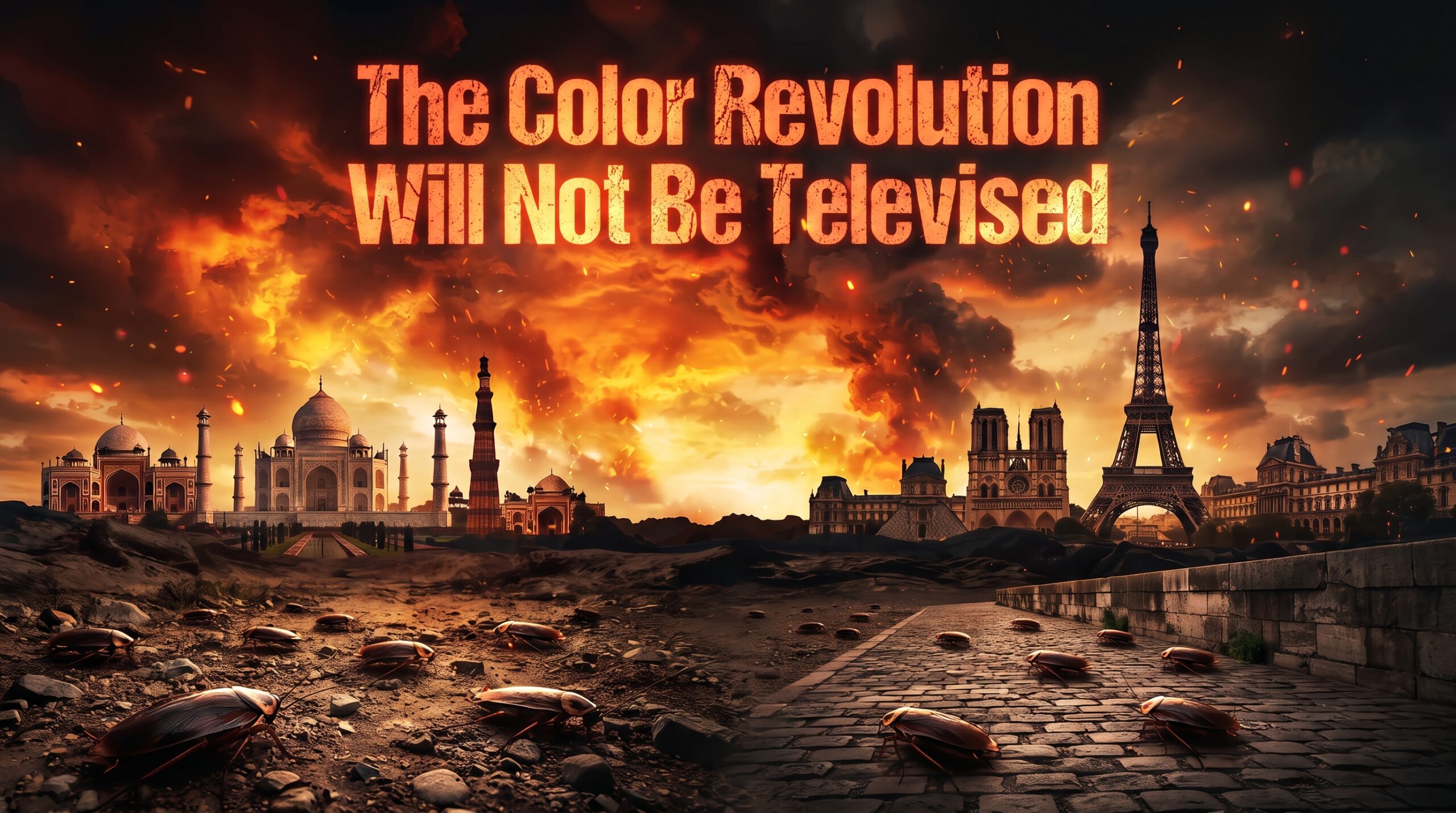
France, India, and the Color Revolution Playbook
Hundreds of French schools reportedly blockaded. University campuses disrupted. Fires, overturned vehicles, police clashes.
Then an emergency response attributed to Prime Minister “Sebastian Loru.”
Pfffftttt.
Who is Loru?
The unresolved name matters. It could be a misspelling, mistranscription, synthetic-news artifact, or mistaken attribution. Sébastien Lecornu appears to be the intended name. But repeated errors can expose a shared feed. Follow the mistake and you may find the source.
Now add India.
A self-described Gen Z movement called the Cockroach Janata Party is said to be protesting voter-roll removals in New Delhi and Mumbai. Its reported demands include the resignation of Gyanesh Kumar. The claimed removals reach into the millions.
Different grievance. Familiar machinery.
France supplies physical pressure through schools and universities. India supplies an electoral-legitimacy crisis. The cockroach supplies a durable, meme-ready symbol. Digital platforms provide coordination and amplification.
This is what the modern color revolution can look like.
That does not mean every protester is controlled, or every grievance invented. The model works better when the anger is real. Organizers do not need to manufacture the current. They need to channel it.
Block the gate. Occupy the campus. Force a response. Circulate the images. Rename the conflict. Personalize the bureaucracy. Demand one official resign. Turn local incidents into a national legitimacy crisis.
Agitate. Amplify. Attack.
The Cockroach Janata Party name should not be dismissed as nonsense. A cockroach survives, scatters, hides and returns. It communicates endurance and decentralization without requiring a fifty-page manifesto.
Who created the first logo? Which language appeared first? Did the branding predate the demonstrations? What do archived posts, timestamps, account-creation dates and early photographs reveal?
The first logo may matter more than the hundredth interview.
Then Canvas enters the picture.
On May 7, 2026, a cyberattack reportedly disrupted Canvas access across Harvard, Stanford and other institutions during finals. ShinyHunters claimed responsibility. Instructure disclosed exposure involving names, email addresses, student IDs and private messages. Attackers allegedly placed messages on login pages.
No operational link between that breach, France and India has been supplied. That edge remains missing.
The capability, however, is sitting in plain sight.
A compromised educational platform can reveal networks, support impersonation, enable targeted messaging and transform a trusted login screen into attacker-controlled broadcast space. One disruption closes the school. Another controls what students see when they attempt to enter.
That is why these clusters belong on the same board.
Not because one headquarters must be issuing synchronized orders. Several hands can pull the same string without knowing one another. Political groups, foreign interests, cybercriminals, platform operators and influence networks can exploit the same genuine pressure.
Watch the language.
“Verification” becomes “disenfranchisement.” Students become “rioters.” A local blockade becomes a country “gripped by chaos.” An outage becomes an occupation. The side naming the event first often captures its momentum.
The hands behind the process will not announce themselves.
They appear in timing, templates, symbols, access and repeated language. Follow the first poster. Trace the first account. Compare the fonts, slogans, short links and printing sources. Find where “Sebastian Loru” first entered the feed.
The street produces the image.
The database identifies the crowd.
The platform delivers the message.
The system decides who counts.
More from Michael Vanacore: michaelvanacore.com
Tags: #MichaelVanacore #MVUltra #HigherEducation #Education #InvestigativeJournalism