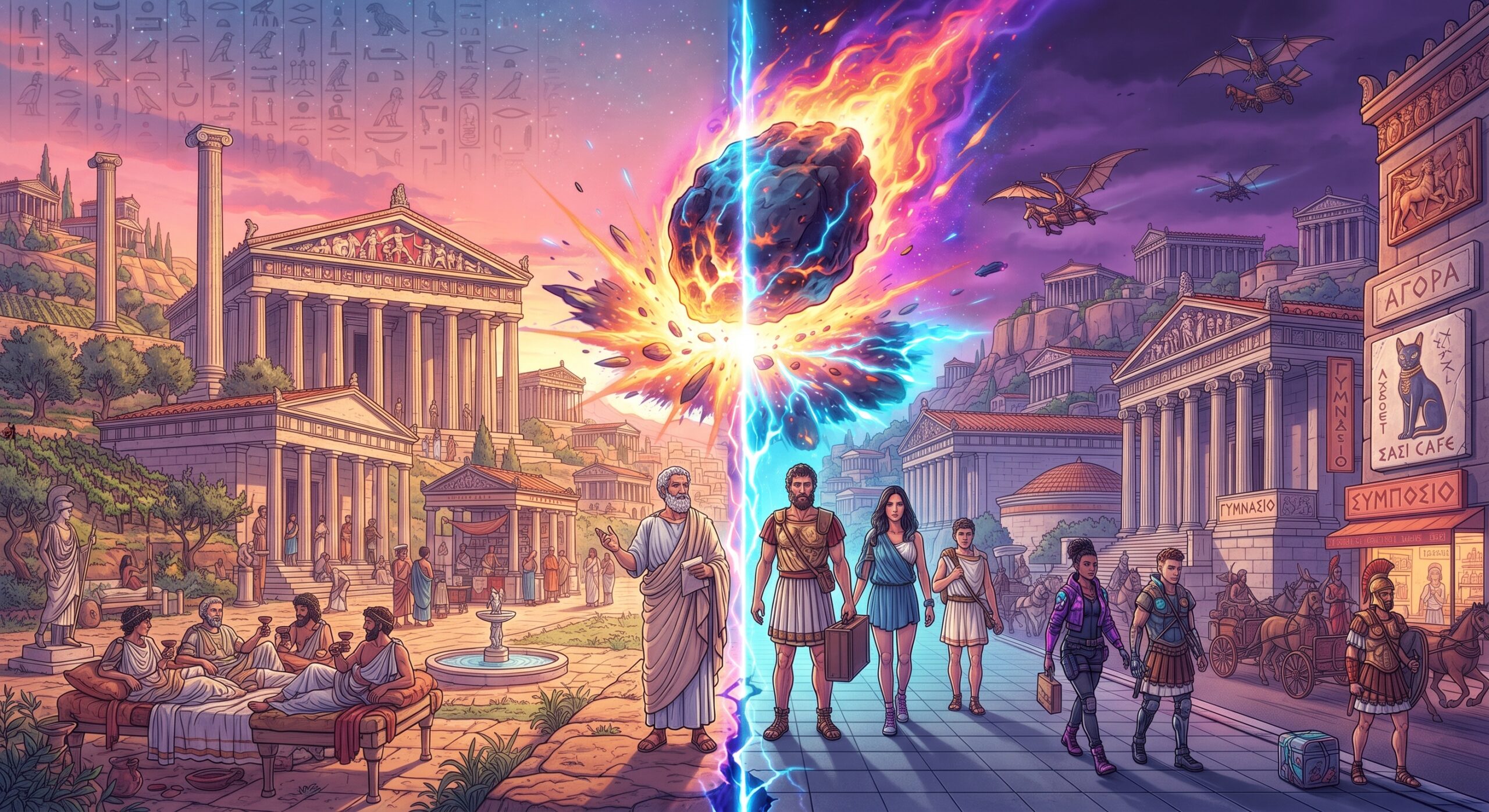
What If the Younger Dryas Ended With a Second Strike?
A circular clay tablet from Nineveh may preserve the passage of something through the ancient sky.
The tablet is K8538. Alan Bond and Mark Hempsell interpreted it as an Assyrian copy of an observation made on June 29, 3123 BC. They connected the moving object in their reconstruction to Köfels, the site of an enormous Alpine landslide in Austria.
The clocks do not cooperate.
K8538 comes from the first millennium BC. The proposed observation belongs to 3123 BC. Köfels is commonly dated to roughly 9,800 years ago. The Younger Dryas began about 12,800 years ago and ended around 11,600 years ago.
Three clocks. Maybe three events.
Or maybe separate encounters with fragments from the same long-lived debris complex.
The Younger Dryas Impact Hypothesis proposes that cosmic fragments struck Earth, hit ice, or exploded in the atmosphere near the beginning of the cooling period. Researchers have reported microspherules, nanodiamonds, melt products, platinum anomalies, and carbon-rich material at widely separated sites.
Under that model, the first encounter helped start the freeze.
Fragments arrive. Fires spread. Glacial drainage systems fail. Freshwater disrupts Atlantic circulation. Temperatures fall. Ecosystems collapse. Human communities scatter toward refugia.
Then, roughly 1,200 years later, the cold ends quickly.
What if another concentration of debris helped end it?
The second encounter would not need to behave like the first. Different fragments, angles, surfaces, and atmospheric conditions could produce another result. Thermal radiation, ignition, atmospheric disruption, accelerated ice loss, failing ice dams, floods, and drowning coastlines.
Fire begins the cold.
Fire helps end it.
Contradictory? Only if nature is required to produce one clean effect at a time.
This model also changes the lost-civilization question. An advanced culture may not have existed only before the Younger Dryas. It could have developed during it.
Twelve centuries is plenty of time for survivors to consolidate, specialize, navigate, study the sky, build protected settlements, and forget what came before. Then the second reset destroys the coastlines best suited to trade.
The machinery disappears. The methods survive.
That makes Göbekli Tepe more interesting. It appears near the Younger Dryas termination as a monumental center built by communities usually described as hunter-gatherers. Maybe it was not civilization beginning from zero. Maybe it was knowledge becoming visible again.
K8538 and Köfels could preserve a later return of the same broad danger. Bond and Hempsell’s reconstruction may point toward Köfels, another scar, or a transmitted memory. Köfels itself could represent a hybrid event:
airburst or seismic disturbance → destabilized slope → catastrophic landslide → frictional melting
The dates do not need to become one date. A fragmented parent body could produce recurring encounters across centuries or millennia. The Taurid complex and Comet Encke provide one searchable orbital direction.
This is not necessarily one lost civilization.
It may be a reset culture. Maybe several.
The full question reaches from submerged coastlines and inherited monuments to underground refuges, astronomical alignments, fire-and-flood traditions, and structures carrying more than one historical clock.
Keep the possibilities separate long enough to test them.
Map the scars. Test the rocks. Reconstruct the sky.
Then follow the debris forward and see which clocks lock together.
Sources & Further Reading
- The British Museum Collection
- The Case of the Younger Dryas Impact Hypothesis, NIH/PubMed Central
- University of Arizona
- Younger Dryas Impact Hypothesis
More from Michael Vanacore: michaelvanacore.com
Tags: #MichaelVanacore #MVUltra #HigherEducation #Younger #Dryas